How AI Agents Are Redefining Construction Accounting
Construction accounting has always been labor-intensive—bills from dozens of vendors, cost codes that need to match the right job, approvals that stall in someone’s inbox, and WIP reports that are outdated the moment they’re printed. AI agents are changing that by doing the repetitive work automatically: reading invoices, coding costs, routing approvals, and updating financials in real time.
This guide covers what AI agents actually do in construction accounting, how they differ from traditional automation, and how to put them to work in your finance stack without replacing your ERP.
What Are AI Agents in Construction Accounting
AI agents for construction accounting are software tools that handle financial tasks on their own—reading invoices, coding costs to jobs, routing approvals, and updating budgets without waiting for someone to click a button. Unlike traditional accounting software that stores data and waits for instructions, AI agents perceive incoming information, make decisions based on your rules and historical patterns, and then take action.
The most common AI agents in construction accounting work across specific workflows:
- AI Job Costing Agent: Reads every bill and codes it to the correct job and cost code based on patterns from your data
- AI Billing Agent: Builds draw packages and AIA-style billings from approved job costs
- AI WIP & Forecasting Agent: Updates work-in-progress reports continuously by connecting financial data with field updates
- AI Compliance Agent: Collects lien waivers and insurance certificates, blocking payments when documentation is missing
- AI Change Order Agent: Tracks pending change requests and flags unapproved scope before it affects your margin
Think of AI agents as a team working in the background. One reads the invoice, another codes it, a third routes it for approval, and a fourth checks compliance documents before payment goes out. They work together, and they work fast.
How AI Agents Differ From Traditional Construction Accounting Automation
Traditional automation in construction accounting depends on rules you configure manually. You set up templates, define exact matching criteria, and build workflows that break the moment a vendor changes their invoice format or a new exception shows up.
AI agents learn from your data instead of relying entirely on pre-built rules. They recognize patterns in how you’ve coded invoices before, adapt when formats change, and flag anomalies rather than failing silently.
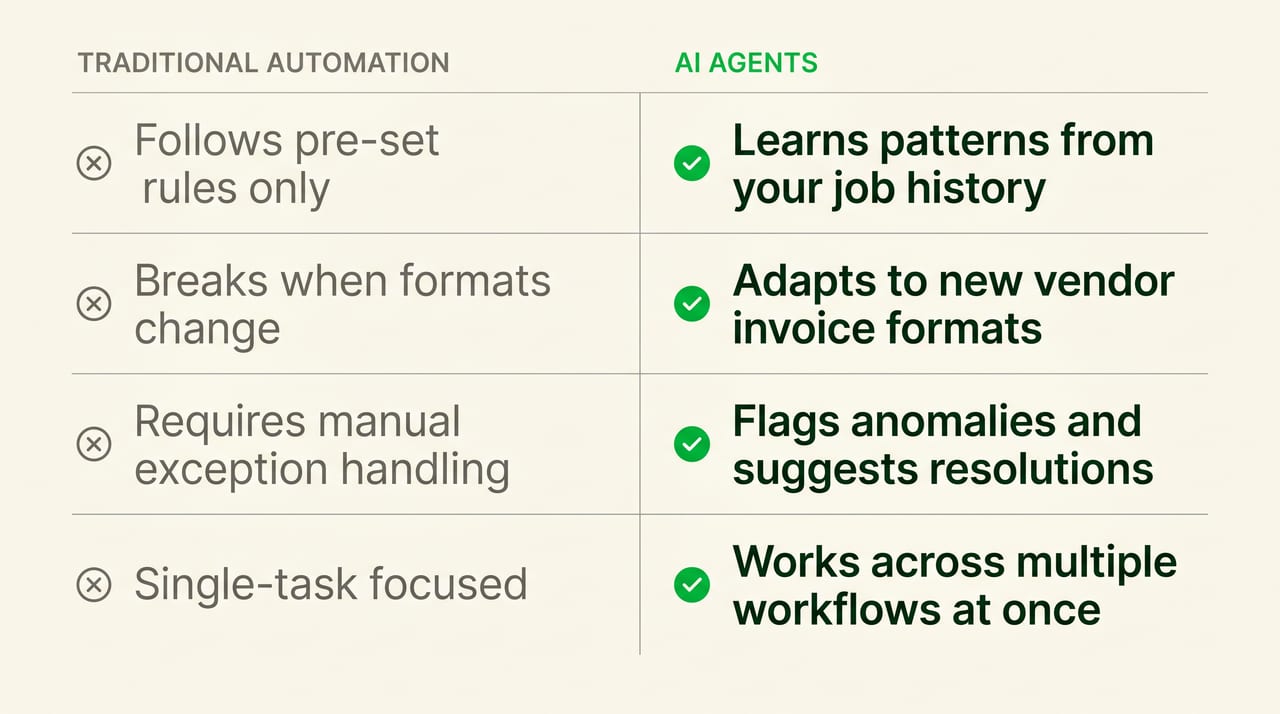
Here’s the practical difference: traditional automation might reject an invoice because the PO number is in a different field than expected. An AI agent recognizes the vendor, matches the line items to your cost codes, and asks for confirmation only when confidence is low.
Types of AI Agents for Construction Accounting
Different agents handle different parts of your financial workflow. Here’s what each one does and why it matters.
AI Job Costing Agent
The job costing agent reads every bill and assigns it to the correct job, phase, and cost code. It learns which vendors typically work on which types of jobs and which cost codes apply to specific line items. Over time, it gets better at matching invoices to the right place without asking for help.
AI Accounts Payable Agent
The AP agent processes vendor invoices from the moment they arrive to the moment they’re queued for approval. It extracts data, validates against purchase orders or contracts, and routes everything for approval. No manual data entry required.
AI Billing and Draw Agent
When it’s time to bill, the billing agent pulls real-time job cost data and generates draw packages or AIA-style billing documents. It formats everything for owner or lender submission, so you’re not rebuilding spreadsheets every month.
AI WIP and Forecasting Agent
Work-in-progress calculations traditionally happen monthly or quarterly. The WIP agent updates continuously as costs post and billings occur. You get a current picture rather than a stale snapshot that’s already outdated by the time you see it.
AI Change Order Agent
Change orders that sit unprocessed erode margin—40% of construction firms report change orders as a significant source of cost overruns. The change order agent tracks pending and approved COs, makes sure they flow into budgets and billing, and flags anything that hasn’t been processed. No more common job costing mistakes like discovering at closeout that you never billed for approved scope.
AI Compliance and Lien Waiver Agent
Before any payment goes out, the compliance agent checks lien waiver status and insurance certificates. If documentation is missing or expired, it requests what’s needed and holds the payment until requirements are met. You don’t pay until you’re protected.
Construction Accounting Workflows AI Agents Automate
The real impact shows up in specific workflows that used to eat hours every week. Let’s walk through the big ones.
Bill Coding and Job Cost Allocation
The old way: someone opens each invoice, looks up the job, finds the right cost code, enters the data, and chases the PM when something doesn’t match. With AI agents, the invoice gets read automatically, matched to the correct job and cost code, and flagged for confirmation only on low-confidence items. The routine work disappears.
Approval Routing and Vendor Payments
AI agents route invoices based on amount thresholds, job assignments, and your approval hierarchy. Once approved, they trigger ACH payments automatically. No more batching payments manually or wondering if something got stuck in someone’s inbox.
Real-Time WIP and Budget Tracking
Traditional WIP is often a monthly calculation that’s already outdated by the time you see it. AI agents update WIP continuously as costs post and billings occur. You’re working from current numbers, not last month’s guess.
Draw Package Creation and AIA Billing
Creating draw packages manually means pulling job costs, calculating percent complete, and formatting everything correctly. AI agents handle this in seconds. They pull current data and assemble the package in the format your lender or owner requires.
Lien Waiver and Insurance Compliance
Tracking waiver status for every vendor on every job is tedious and error-prone. AI agents monitor compliance automatically, request missing documents, and hold payments until requirements are met. You don’t have to remember who owes what.
Benefits of AI Agents for Construction Finance Teams
The business case comes down to three outcomes that matter for builders running multiple projects.
Margin Protection and Cash Leakage Prevention
Real-time visibility into job costs helps catch missed billables, duplicate payments, and unprocessed change orders before they erode profit. You can’t control what you can’t see. AI agents give you that visibility as work happens, not weeks later.
Hours Saved on Manual Data Entry
The paper chase disappears. Invoice entry, receipt coding, and chasing PMs for approvals all shrink dramatically when AI agents handle the routine work. Your team spends less time on data entry and more time on decisions that require judgment—exactly how builders grow without adding overhead.
Scaling Without Adding Accounting Headcount
Finance teams can handle more projects and higher invoice volume without growing back-office headcount proportionally. The agents do the repetitive work. Your team focuses on analysis and exceptions.
How AI Agents Integrate With Construction ERPs and Project Management Tools
You don’t have to replace your existing systems—only 20% of contractors operate on a single platform today. AI agents sit on top of your ERP, not instead of it, with two-way sync that keeps everything aligned.
- ERP integration: Two-way sync with QuickBooks, Sage, or Foundation keeps your general ledger and job cost ledger current
- Project management: Pulls budget and phase data from Procore or similar platforms
- Banking connectivity: Links to accounts for payment execution and reconciliation
The key point here: AI agents work with your existing tools rather than forcing a rip-and-replace. You keep your ERP. You keep your project management software. The agents connect everything and handle the work in between.
How to Implement AI Agents in Your Construction Accounting Stack
Getting started doesn’t require a massive overhaul. Here’s a practical path that works for most builders.
1. Audit Your Current Financial Workflows
Identify where manual work and delays occur. Invoice processing, cost coding, WIP calculation, and compliance tracking are common pain points. Start there.
2. Connect Your ERP and Project Management Systems
Link your accounting software and project tools so AI agents can access job structures and cost codes from day one. The connection is what makes everything else possible.
3. Deploy Agents on High-Volume Workflows First
Start with AP and job costing. These typically carry the highest volume and greatest manual burden. Let the agents learn from your coding patterns before expanding to other workflows.
4. Set Approval Rules and Spend Controls
Configure approval thresholds, routing logic, and spending limits. AI agents enforce these rules automatically once they’re set. You define the guardrails; the agents stay inside them.
5. Measure ROI and Expand Agent Coverage
Track time saved, errors caught, and margin improvements. Then expand into billing, WIP, and compliance agents as confidence grows. Start small, prove value, and scale from there.
Security, Controls, and Audit Considerations for AI Accounting Agents
A reasonable question: can AI be trusted with financial data? The answer depends on how the platform handles security and oversight.
- Data security: Look for encryption, access controls, and SOC 2 compliance standards
- Approval workflows: AI agents recommend and route, but humans approve and authorize payments
- Audit trails: Every action is logged with timestamps for compliance and review
AI agents work within your approval framework. They don’t bypass human oversight. They handle the repetitive work so your team can focus on decisions that require judgment. You stay in control.
Putting AI Agents to Work in Your Construction Finance Stack
The shift from manual to AI-driven accounting isn’t theoretical anymore. According to McKinsey, 44% of CFOs surveyed used gen AI for over five finance use cases in 2025, up from just 7% the year prior. Builders running $10M+ in annual revenue are already using AI agents to handle job costing, AP, billing, and compliance in one place.
Adaptive is purpose-built for this. The platform gives you a team of AI agents that automate manual accounting work, reconcile financials with field updates, and deliver real-time financial control—without replacing your ERP.
Frequently Asked Questions About AI Agents for Construction Accounting
Will AI agents replace construction accountants and CPAs?
No. AI agents handle repetitive data processing and routing, freeing accountants and CPAs to focus on analysis, strategy, and advisory work. The agents do the tedious parts. Your team does the thinking.
Can AI agents handle construction bookkeeping from invoice to payment?
Yes. AI agents can ingest invoices, code them to jobs, route them for approval, execute payments, and track lien waivers without manual intervention at each step.
How accurate are AI agents at coding invoices to jobs and cost codes?
Accuracy improves as AI agents learn from your historical coding patterns. Most platforms allow review and correction of low-confidence items before posting, so you maintain control while the system gets smarter.
Do AI accounting agents integrate with Sage, QuickBooks, and Foundation?
Most construction-focused AI platforms offer two-way sync with major ERPs, including QuickBooks, Sage 100/300, and Foundation, to keep systems aligned without duplicate entry.